

For product teams, project managers, business leaders, and anyone responsible for deciding what gets done first, prioritization is one of the most valuable skills to develop.
The backlog keeps growing, stakeholders each believe their request is the urgent one, and the people doing the work are left wondering why priorities shift every fortnight. A good prioritization process helps teams focus limited time, money, and resources on the work that matters most.
The fundamental challenge is that there is rarely one obvious answer. A feature might have enormous potential value but require months of development. Another might be quick to deliver but have limited impact. A third could be essential to customers even if it doesn’t generate immediate revenue.
In this post, we’ll explore 4 of the most effective prioritization frameworks: RICE, MoSCoW, value vs. effort, and the Kano model. While some originated in software development, their principles apply equally well to operations, event planning, marketing campaigns, physical product design, and general business strategy.
1. RICE scoring model: Best for data-driven, quantitative decisions
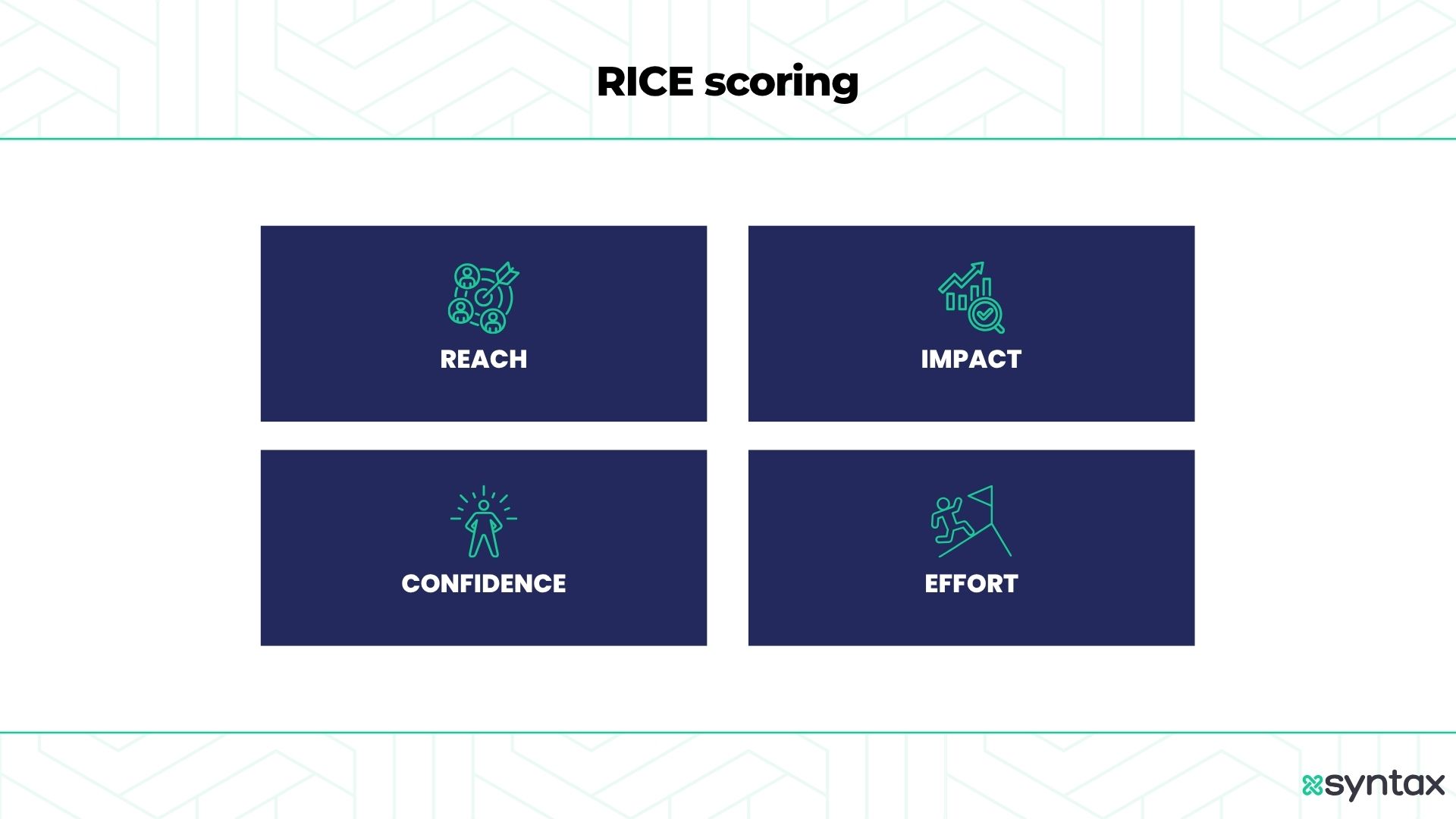
Originally created to assess software features, the RICE scoring model is a quantitative framework designed to minimize emotional bias by evaluating projects or initiatives across 4 distinct criteria.
Its biggest strength is the confidence factor. A shiny idea backed by gut feel is penalised against one backed by data, which discourages optimism bias. Because everything is reduced to a single number, it also gives you a defensible way to rank dozens of items.
How it works
Each project or task is given a single score using a straightforward formula: (Reach × Impact × Confidence) ÷ Effort. The higher the score, the higher the priority.
- Reach: How many people, customers, or internal processes will this initiative impact over a given timeframe? E.g. 500 employee workstations upgraded per month, or 10,000 customers receiving a new mailing.
- Impact: How much will this initiative drive the target goal or metric? Use a standardized scale:
- 3 = Massive impact
- 2 = High impact
- 1 = Medium impact
- 0.5 = Low impact
- 0.25 = Minimal impact
- Confidence: How sure are you about your estimates for reach, impact, and effort? This percentage acts as a reality check against over-optimism:
- 100% = High confidence (backed by verified operational data or past project metrics)
- 80% = Medium confidence (supported by preliminary vendor quotes or internal estimates)
- 50% = Low confidence (mostly gut feeling or educated guesses)
- Effort: How much total resource time (weeks, hours, or budget units) will this take to complete?
Watch out for false precision. A score of 42.7 against 41.9 isn’t a meaningful difference, and the inputs are still estimates. Treat RICE as a conversation starter, and don’t use it when you have no usage data to anchor reach and impact.
When to use it
- Data-rich decisions: Ideal when you have quantifiable metrics or historical performance data to work with.
- Large backlogs or project pipelines: Great for objectively ranking competing project proposals across different departments.
- Executive buy-in: Useful when presenting project proposals to stakeholders who prefer clear, data-backed justifications.
2. MoSCoW method: Best for fixed-deadline and time-boxed projects
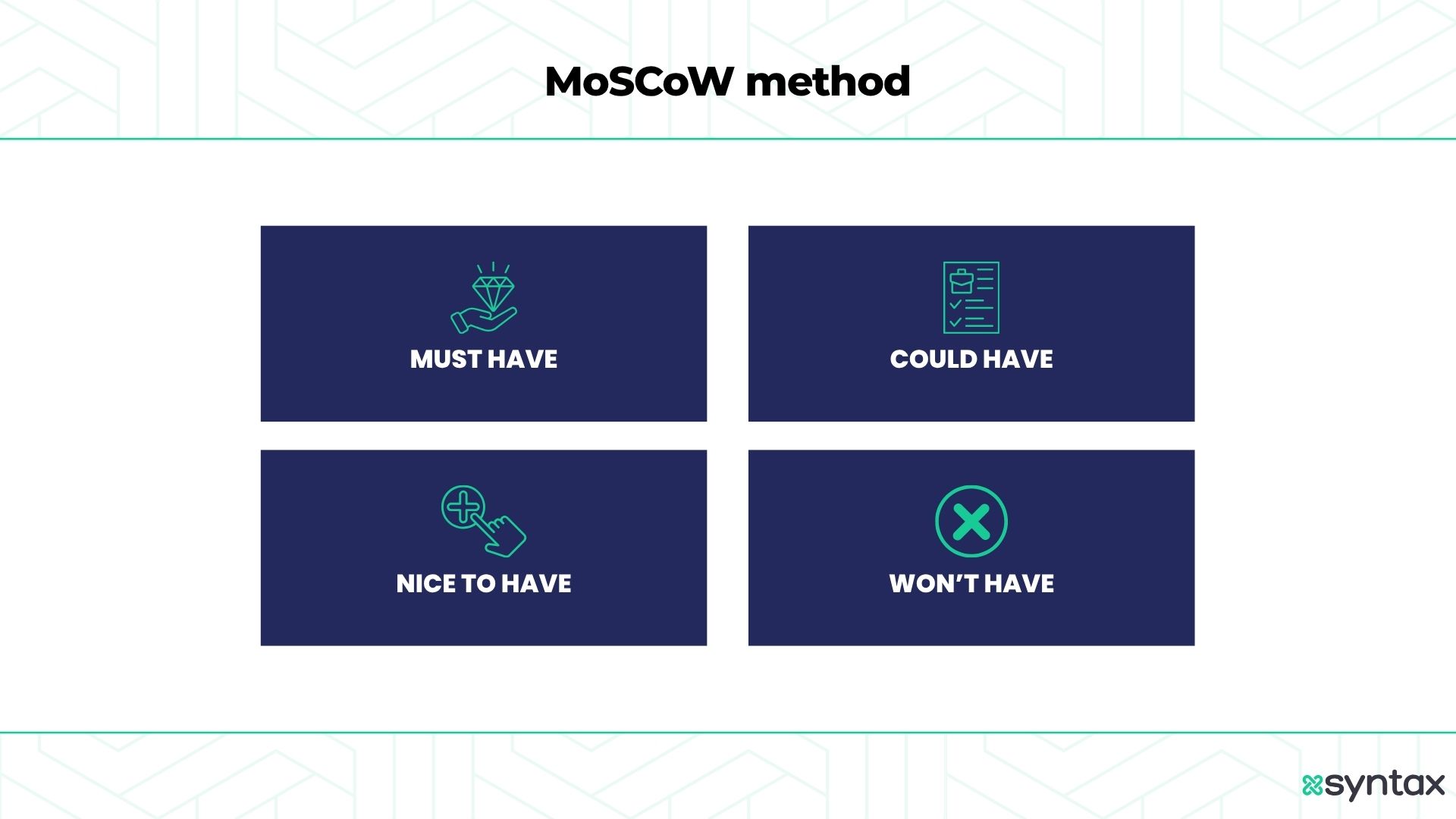
The MoSCoW method is a qualitative technique that categorizes requirements or deliverables into 4 distinct groups based on their criticality to a project’s success.
Its beauty is its simplicity. Anyone can understand it in 2 minutes, which makes it ideal for workshops with non-technical stakeholders. The “Won’t have” category is the most underrated. Writing down what you’re not doing manages expectations early and prevents scope creep later.
How it works
Tasks, scope items, or deliverables are divided into 4 buckets:
- Must have: Non-negotiable requirements essential for project completion. Without these, the project fails, legal standards are breached, or the launch cannot occur (e.g., safety permits for a construction site, fire safety plan for an event).
- Should have: Highly valuable initiatives that add significant quality, but are not strictly vital. Workarounds usually exist if they’re delayed.
- Could have: “Nice-to-have” extras that offer incremental improvements. These are the first items dropped if budget, staffing, or timeline pressures occur.
- Won’t have (this time): Out-of-scope items explicitly agreed upon for the current phase or budget cycle. Documenting these prevents scope creep and manages expectations upfront.
Watch out for “Must have” inflation. Left unchecked, stakeholders will label everything a Must, and the framework collapses. A useful discipline is to cap Musts at around 60% of your available capacity, leaving contingency in the Shoulds and Coulds. Also be aware that MoSCoW tells you what matters, but not the order within each bucket.
When to use it
- Fixed timelines & budgets: Ideal for event management, construction, product launches, or client deliverables where timeboxing is critical.
- Managing scope creep: Excellent for establishing firm boundaries with clients, executives, or cross-departmental committees.
- Resource realignment: Helpful when a project is running over budget and you need to quickly determine what can be cut.
3. Value vs. effort matrix: Best for quick alignment and strategy sessions
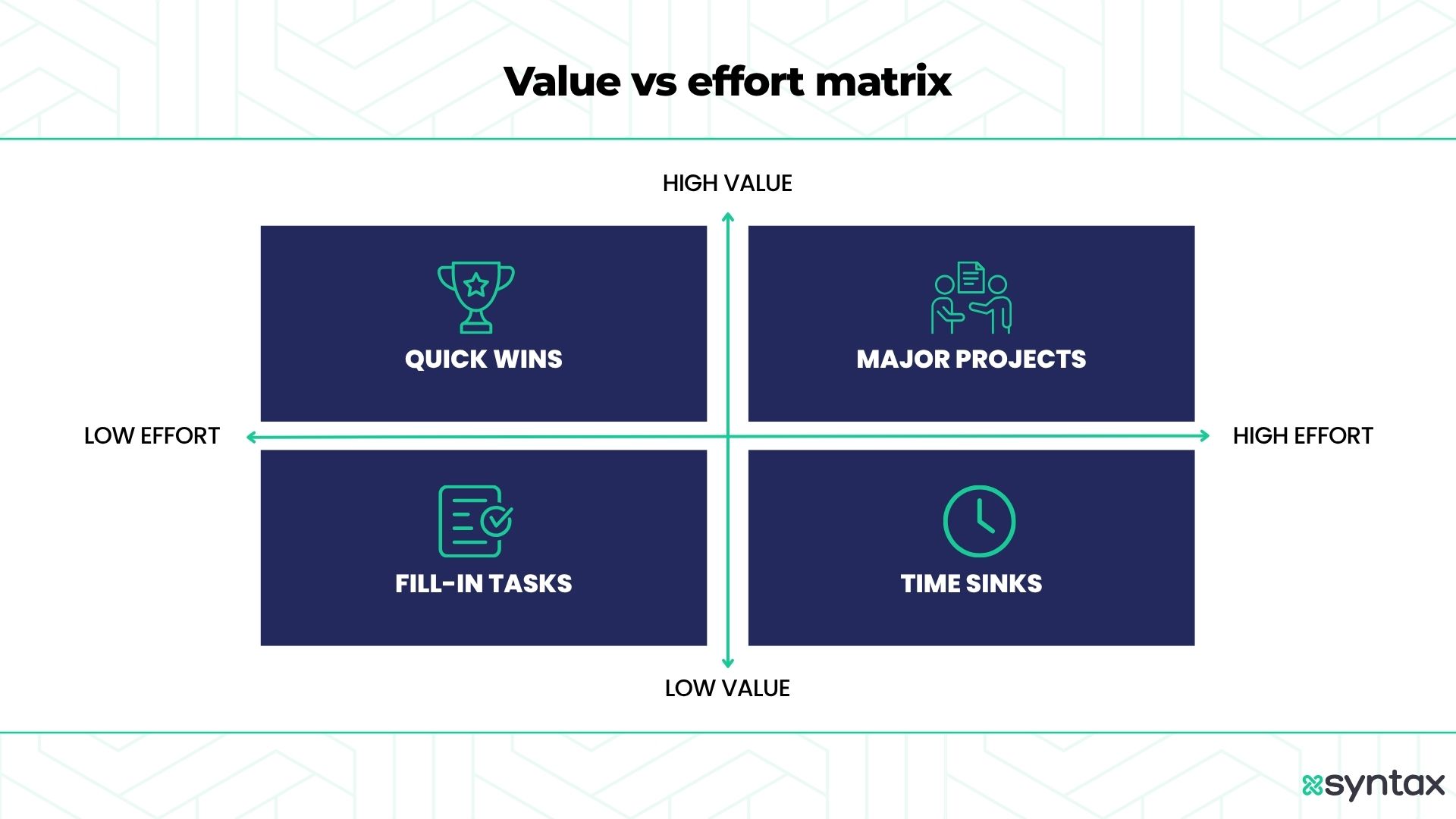
This visual tool plots projects along two axes: the Value created for the business or customer versus the Effort (or cost) required to execute it.
It’s quick and collaborative. Put a whiteboard or Miro board in front of your team, write the options on sticky notes, and debate where each belongs. The discussion matters more than the final placement, because it surfaces assumptions about complexity and benefit that would otherwise stay hidden. Engineers often spot hidden effort that product owners haven’t considered, and vice versa.
How it works
Initiatives are plotted into one of 4 quadrants:
- Quick wins (high value, low effort): Highest priority. Yield maximum returns with minimal time or capital investment.
- Major projects (high value, high effort): Strategic, long-term goals. Require careful planning, dedicated budgeting, and phased execution.
- Fill-in tasks (low value, low effort): Low priority. Address during downtime or delegate to junior team members.
- Time sinks (low value, high effort): Deprioritize, simplify, or eliminate completely.
Watch out for subjectivity and a bias towards quick wins. A team that only ever picks the bottom-right quadrant will deliver a stream of small improvements while neglecting the strategic work that changes the product. Make sure big bets get a fair hearing.
When to use it
- Brainstorming workshops: Perfect for collaborative planning sessions with cross-functional team leads.
- Resource-constrained teams: Ideal for smaller teams looking to maximize output with limited staffing or budget.
- Rapid decision-making: Great when detailed data is unavailable, but team domain knowledge is strong.
4. Kano model: Best for customer satisfaction and operational excellence
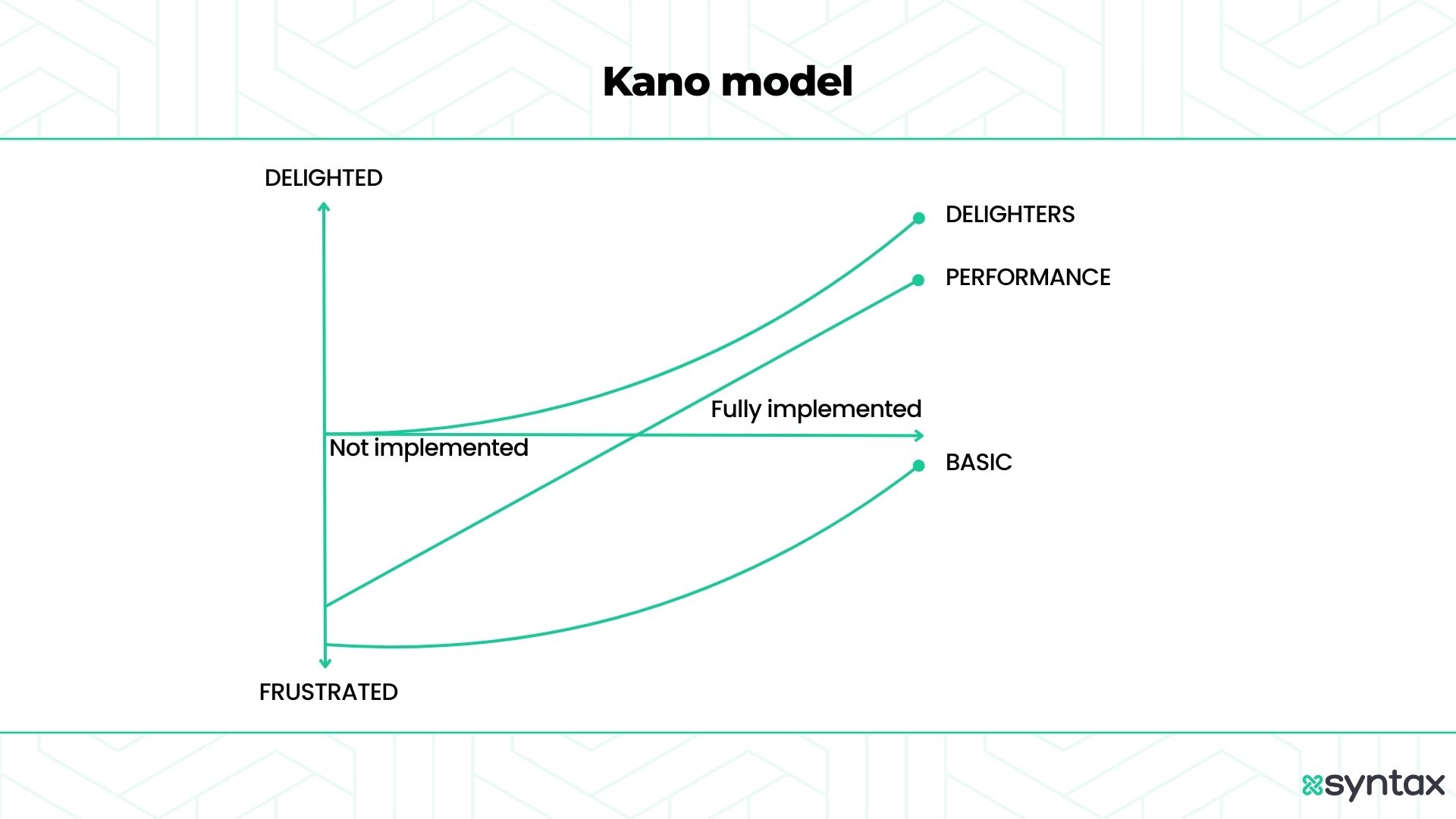
Developed by Professor Noriaki Kano in the 1980s, the Kano model categorizes features and project deliverables based on how likely they are to satisfy users or key stakeholders.
This framework has a built-in lifecycle effect. Today’s delighter becomes tomorrow’s basic expectation. Features like one-click checkout and mobile responsiveness once wowed users, and now they’re simply assumed.
How it works
Unlike models that focus strictly on internal cost or ROI, Kano evaluates requirements against user perception and emotional response. Project features fall into 5 distinct categories:
- Basic (must-be): Baseline features that users simply expect to be there; missing them causes major dissatisfaction, but having them won’t generate extra excitement.
- Performance (satisfiers): Features where user satisfaction directly increases the better or faster you deliver them.
- Delighters (attractive): Unexpected perks or features that users didn’t ask for, creating high excitement if included but no disappointment if omitted.
- Indifferent: Features that users do not care about either way, yielding zero impact on satisfaction regardless of effort spent.
- Undesired (reverse): Unwanted features or friction points that actively frustrate users and decrease satisfaction if present.
Watch out for the research overhead. Kano requires surveys and analysis, so it’s too heavy for day-to-day backlog grooming. It also tells you nothing about cost, so pair it with an effort estimate.
When to use it
- Service design and hospitality: Ideal when customer retention, brand loyalty, and review ratings drive business success.
- Competitive differentiation: Great when operating in crowded markets where basic offerings are standardized across competitors.
- Process redesign: Useful when reviewing existing operations to ensure baseline expectations are met before spending resources on decorative perks.
Core principles for any prioritization effort
Regardless of which framework fits your specific workflow, keep these principles in mind:
- Combine methods when appropriate: Frameworks are complementary. You might use Kano to identify customer priorities during market research, plot those ideas on a value vs. effort matrix during quarterly planning, and apply MoSCoW to lock down the exact scope for a fixed deadline.
- Re-evaluate regularly: Priorities are dynamic. Market conditions, operational bottlenecks, and budget shifts require teams to re-evaluate backlogs periodically.
- Document the rationale: Always record why a project received its score or category. Transparency prevents rework, reduces misunderstandings, and aligns stakeholders around shared goals.
By shifting from gut-feel decision-making to structured frameworks, teams across any industry can allocate resources effectively, reduce friction, and deliver meaningful results. The best prioritisation happens when the inputs are honest, the criteria are agreed in advance, and the outcomes are communicated transparently.
Whichever technique you choose, be clear about the assumptions behind your scores, revisit priorities as new information arrives, and make it easy for stakeholders to understand why something is at the top of the list.
This post is also published on Medium.com.